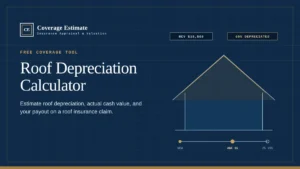
A roof depreciation calculator helps homeowners answer the question that matters most after a hail or windstorm: how much will the insurance company actually pay to replace the roof? The answer is rarely the full replacement cost. Roof age, the settlement terms in your policy, and your deductible all reduce the check, sometimes dramatically.
That gap surprises people.
A roof that costs $15,000 to replace can produce a first payment of under $1,000 when the roof is middle-aged and the policy carries a percentage wind and hail deductible. Whether the rest of the money is paid later depends on whether the policy settles roofs at replacement cost, at actual cash value, or on a roof payment schedule.
This guide explains how to use the calculator below, how insurers depreciate roofs, the difference between RCV, ACV, and roof payment schedules, how roof age is determined, and what to do when the insurer’s numbers do not match yours.
Use the Roof Depreciation Calculator
The calculator below works through a roof insurance claim the way most claim estimates are structured, from replacement cost to the payment you can expect.
It can help estimate:
- Replacement cost value (RCV) of the roof
- Depreciation in dollars and as a percentage
- Actual cash value (ACV) after depreciation
- The deductible applied, including percentage wind and hail deductibles
- The initial payment and any recoverable depreciation
- The total payment if the roof is replaced
- Your out-of-pocket cost and the roof’s estimated remaining life
The calculator processes entries locally in your browser. The information you enter is not transmitted or stored. Results are a preliminary planning estimate, not a claim determination, roofing estimate, or coverage opinion.
What Is Roof Depreciation?
Depreciation is the loss in value of a roof as it ages and wears. An insurer that pays actual cash value starts with what it would cost to replace the roof today, then subtracts depreciation to reflect the portion of the roof’s useful life that has already been used up.
The basic relationship is simple:
Actual cash value = replacement cost value − depreciation
Most roof estimates calculate depreciation on a straight-line basis. If a roof covering is expected to last 25 years and it is 12 years old, it has used about 48% of its life, so 48% of the replacement cost is deducted. Adjusters may adjust that figure for condition, and many estimates cap depreciation at a maximum percentage so that even a very old roof retains some value.
How depreciation affects your payment depends on the settlement terms in your policy, which is why the calculator asks for the settlement type separately from age and material.
RCV vs. ACV vs. Roof Payment Schedules
Roof coverage generally falls into one of three settlement structures. Your declarations page and any roof endorsement will tell you which one applies. Some policies use one basis for wind and hail damage and another for other perils, so read both.
| Settlement Type | How It Pays | Is Depreciation Recoverable? |
|---|---|---|
| Replacement cost (RCV) | Pays ACV minus the deductible first, then releases the withheld depreciation after the roof is replaced | Yes, usually after you complete the work and submit proof within the policy’s time limit |
| Actual cash value (ACV) | Pays replacement cost minus depreciation, minus the deductible | No |
| Roof payment schedule | Pays a fixed percentage of replacement cost based on roof age and often material, minus the deductible | No |
Replacement Cost With Recoverable Depreciation
Under a replacement cost policy, the insurer typically pays in two stages. The first check is the actual cash value minus your deductible. The depreciation that was withheld, often called recoverable depreciation or holdback, is released after the roof is replaced and you provide the final invoice or other proof of completion.
Your total payment if you replace the roof is the full replacement cost minus the deductible. Policies usually set a deadline for completing the replacement and claiming the holdback, and the time allowed varies by policy and state.
Actual Cash Value Only
Some policies, and some roof endorsements, pay only actual cash value for the roof. The depreciation is never paid back, even if you replace the roof. On an older roof, this can leave a large gap between the claim payment and the contractor’s price.
Roof Payment Schedules
A roof payment schedule replaces the depreciation calculation with a table. The policy lists the percentage of replacement cost the insurer will pay for roofs of a given age, and sometimes a given material. A newer roof may receive most of its replacement cost, while an older roof may receive a small fraction. Like ACV, the reduction is not recoverable.
Schedules differ by insurer and endorsement, so the calculator’s default percentages are illustrative only. Replace them with the figures in your policy.
How to Use Each Input
Roofing Material
Choose the roof covering on the damaged slopes. Each material shows a general industry range for expected service life, and the calculator uses the midpoint of that range unless you enter an override. If your claim estimate lists a specific life expectancy, enter it in the advanced options.
Roof Age and Condition
Enter the roof’s age in years as of the date of loss. The condition setting adjusts effective age: a roof in better-than-typical condition is treated as 85% of its actual age, a typical roof as 100%, and a worn or poorly maintained roof as 115%. Condition does not apply to roof payment schedules, which use actual age.
Roof Size
Enter the roof area in squares or square feet. One roofing square equals 100 square feet of roof surface. This is roof surface, not floor area, and is usually larger because of pitch and overhangs. Use a measurement report or an estimate’s square count when you have one.
Replacement Cost per Square or Contractor Estimate
The cost per square fills in automatically with a typical planning value for the selected material, including tear-off of one layer. Override it with your local price. If you have a contractor estimate or the insurer’s estimate, enter the total instead. It will be used as the replacement cost value and will include items such as underlayment, flashing, drip edge, ventilation, permits, and overhead and profit if they are in that estimate.
Settlement Type and Deductible
Choose the settlement type from your policy. For the deductible, choose a flat dollar amount or a percentage of dwelling coverage. Percentage deductibles are common for wind and hail in many regions. A 2% deductible on a home with $350,000 of dwelling coverage is $7,000, regardless of the size of the roof claim.
Advanced Options
The maximum depreciation defaults to 80%, and the waste allowance defaults to 10% of measured squares. Both are planning assumptions, not standards. Insurers, estimating software, and individual adjusters use different caps and waste factors, and complex roofs with many hips and valleys usually need more waste than simple gables.
How the Calculator Works
The calculator follows these steps.
Replacement Cost Value
When you enter a roof size and cost per square:
Priced squares = measured squares × (1 + waste allowance)
RCV = priced squares × replacement cost per square
When you enter a contractor estimate, that amount is used as RCV and the size, cost per square, and waste allowance are not used for pricing.
Depreciation and ACV
For replacement cost and ACV settlements:
Effective age = roof age × condition factor (0.85, 1.00, or 1.15)
Depreciation % = effective age ÷ expected life, limited to the maximum depreciation cap
Depreciation = RCV × depreciation %
ACV = RCV − depreciation
For a roof payment schedule, the calculator finds the age band for the roof’s actual age (0–4, 5–9, 10–14, 15–19, or 20 or more years) and uses that schedule percentage as the payment basis. The reduction from RCV is shown in place of depreciation.
Payments
The deductible is taken from the first payment:
Initial payment = ACV − deductible (not less than $0)
Under replacement cost settlement:
Total payment if replaced = RCV − deductible (not less than $0)
Recoverable depreciation = total payment if replaced − initial payment
Under ACV or a roof schedule, the total payment equals the initial payment and nothing is recoverable. In every case:
Out-of-pocket if replaced = RCV − total payment
Remaining life = expected life − effective age (not less than zero)
The status block flags claims that may not exceed the deductible, large out-of-pocket gaps under ACV or schedule terms, and roofs at or beyond their expected life.
Example Roof Depreciation Calculation
Suppose a homeowner files a hail claim with these details:
- Architectural asphalt shingles, 20 to 30 year range, 25-year midpoint
- 12-year-old roof in typical condition
- 25 squares measured
- $550 per square installed, including tear-off
- 10% waste allowance and 80% depreciation cap
- Replacement cost settlement with recoverable depreciation
- 2% wind and hail deductible on $350,000 of dwelling coverage
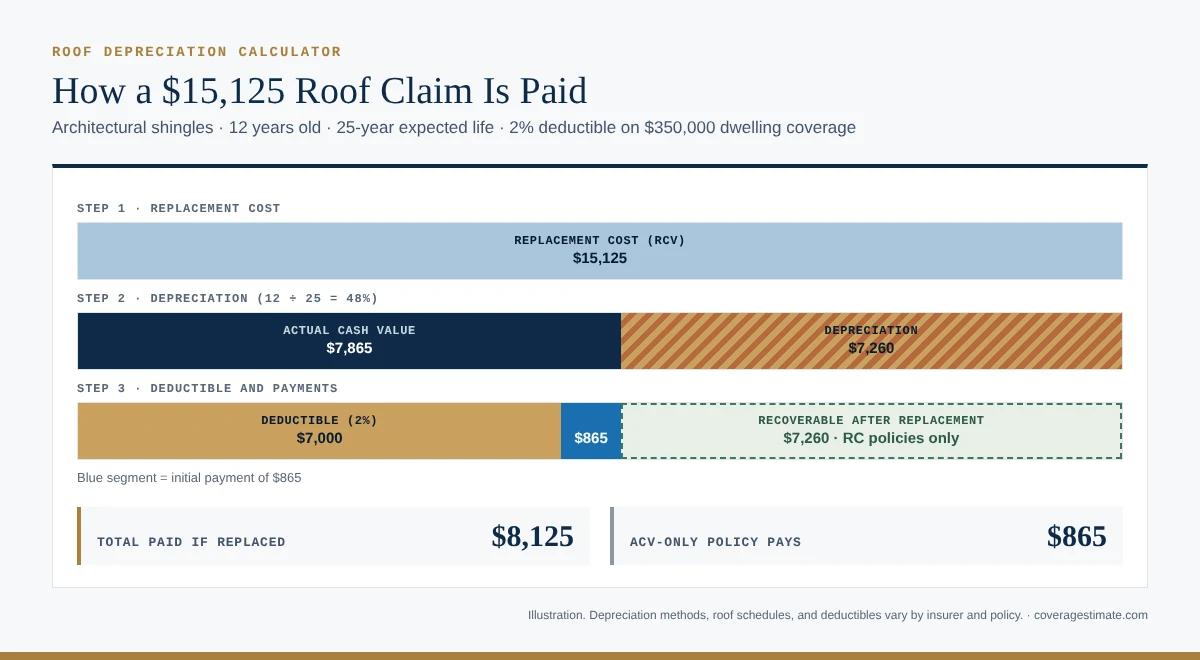
Priced squares are 25 × 1.10 = 27.5. The replacement cost is 27.5 × $550 = $15,125.
Depreciation is 12 ÷ 25 = 48%, well under the 80% cap. That is $15,125 × 48% = $7,260, leaving an ACV of $7,865.
The deductible is 2% × $350,000 = $7,000. The initial payment is $7,865 − $7,000 = $865.
After the roof is replaced and the final invoice is submitted, the insurer releases $7,260 of recoverable depreciation, for a total payment of $8,125. The homeowner’s out-of-pocket cost is the $7,000 deductible. The roof had an estimated 13 years of remaining life.
Notice how small the first check is. Under an ACV-only policy, $865 would be the entire payment, and the homeowner would pay $14,260 toward a new roof.
Click Load Example in the calculator to see these numbers.
Typical Roof Lifespans and Replacement Costs
The table below shows the general planning ranges the calculator uses. Actual lifespan depends on climate, installation quality, ventilation, and maintenance. Prices vary widely by region, roof complexity, and market conditions, especially after a major storm.
| Roofing Material | Typical Service Life | Midpoint Used | Planning Cost per Square, Installed |
|---|---|---|---|
| 3-tab asphalt shingles | 15 to 25 years | 20 years | $350 to $550 |
| Architectural / dimensional asphalt | 20 to 30 years | 25 years | $450 to $700 |
| Impact-resistant (Class 4) asphalt | 25 to 35 years | 30 years | $550 to $850 |
| Metal, standing seam | 40 to 70 years | 55 years | $1,000 to $1,800 |
| Metal, exposed fastener panels | 20 to 40 years | 30 years | $500 to $900 |
| Clay or concrete tile | 40 to 70 years | 55 years | $1,000 to $2,000 |
| Natural slate | 60 to 100 years | 80 years | $1,500 to $3,000 |
| Wood shake | 20 to 40 years | 30 years | $700 to $1,200 |
| Modified bitumen (low slope) | 15 to 25 years | 20 years | $450 to $800 |
| TPO / EPDM single-ply (low slope) | 20 to 30 years | 25 years | $500 to $900 |
These are planning figures, not quotes. An insurer’s estimate may use a different life expectancy for the same material, and that single assumption can change the depreciation by thousands of dollars.
How Insurers Determine Roof Age
Because depreciation is driven by age, roof age is one of the most frequently disputed facts in a roof claim. Insurers and adjusters commonly rely on:
- Building permit records for the last reroof
- Contractor invoices, contracts, and manufacturer warranty registrations
- Home inspection reports from a purchase
- Prior insurance applications, inspections, and underwriting photos
- Aerial and satellite imagery showing when the roof changed
- Physical indicators such as granule loss, shingle brittleness, and manufacturing details
If the insurer lists an age older than you believe is correct, provide documentation. A permit or dated invoice is usually the strongest evidence. If only part of the roof was replaced, the ages of different slopes may differ.
Cosmetic Damage and Matching
Two policy issues often decide how much of the roof is covered at all.
Cosmetic Damage Exclusions
Some policies, particularly for metal roofs, include a cosmetic damage exclusion or endorsement. It generally excludes hail dents and marks that affect appearance but do not let water in or shorten the roof’s life. Whether this applies, and how “functional” damage is defined, depends entirely on your policy wording.
Matching
When only some slopes are damaged, the question becomes whether the insurer will pay to replace undamaged slopes so the roof matches. Treatment of matching varies by policy and by state. Some policies address it directly, and some limit it by endorsement. If replacement shingles are discontinued or the new material will not reasonably match, raise the issue with the adjuster and ask how the policy handles it.
Steps to Document a Roof Claim
Good documentation protects both the claim amount and the recoverable depreciation.
- Photograph the roof, gutters, downspouts, siding, window screens, and outdoor equipment soon after the storm, with dates.
- Note the date and time of the storm and save local weather reports or hail reports if available.
- Make temporary repairs, such as tarping, to prevent further damage, and keep the receipts.
- Gather proof of roof age: permits, invoices, warranties, and inspection reports.
- Report the claim promptly and keep a log of every call, email, and inspection.
- Request a copy of the insurer’s line-item estimate, including the life expectancy and depreciation used.
- Get a detailed written estimate from a licensed roofer for comparison.
- After replacement, submit the final invoice promptly to claim recoverable depreciation before any policy deadline.
Common Roof Claim Mistakes
Assuming the First Check Is the Final Payment
Under replacement cost settlement, the first check is usually only ACV minus the deductible. The holdback comes later, but only if you replace the roof and follow the policy’s procedure.
Missing the Recoverable Depreciation Deadline
Policies commonly limit how long you have to complete repairs and claim withheld depreciation. Ask for the deadline in writing.
Ignoring a Percentage Deductible
A percentage deductible is based on dwelling coverage, not the size of the claim. On a high-value home, it can consume most of a modest roof claim.
Accepting the Roof Age Without Checking
An age error of a few years can shift depreciation by thousands of dollars. Verify the age in the estimate against your records.
When to Get a Second Opinion
If the numbers do not add up, you have options, and the right one depends on the size of the difference and the nature of the disagreement.
Start by asking the adjuster to explain the estimate line by line and to reinspect with your roofer present. Many disagreements over missed slopes, accessories, or measurements are resolved this way.
If the disagreement is over the amount of the loss, many property policies include an appraisal clause. Each side selects an appraiser, and an umpire resolves differences. Appraisal terms, costs, and whether appraisal applies to a given dispute depend on the policy and state law.
A licensed public adjuster can prepare an independent estimate and handle the claim on your behalf, usually for a percentage of the settlement. Public adjuster licensing and fee rules vary by state. For disputes over coverage or claim handling, an attorney may be the appropriate professional. If you would like a second look at a roof claim, you can contact us.
Limitations of the Roof Depreciation Calculator
The calculator is a planning tool. It does not:
- Determine whether the damage is covered or caused by a covered peril
- Read your policy, endorsements, or roof payment schedule
- Price individual line items such as decking, flashing, gutters, or code upgrades
- Reflect a specific insurer’s depreciation tables or estimating software settings
- Account for partial roof repairs, multiple layers, or steep-slope and high-roof charges
- Determine matching obligations or the effect of a cosmetic damage exclusion
- Guarantee any claim payment
For a broader view of how depreciation affects other property, our Actual Cash Value Calculator applies the same principles to belongings and building components. To check whether your overall dwelling limit keeps pace with rebuilding costs, which also affects any percentage deductible, use the Home Replacement Cost Calculator.
Frequently Asked Questions
How much does insurance depreciate a roof per year?
Under straight-line depreciation, the annual rate is 100% divided by the expected life. A roof with a 25-year expected life loses about 4% of its replacement cost value per year, and a 20-year roof about 5%.
Will insurance pay for a 20-year-old roof?
It depends on the policy. Under replacement cost settlement, a covered loss can still be paid at full replacement cost minus the deductible once the roof is replaced. Under ACV or a roof payment schedule, the payment on a 20-year-old asphalt roof may be a small fraction of replacement cost. Some insurers also restrict coverage for older roofs at renewal.
What is recoverable depreciation on a roof claim?
It is the depreciation withheld from the first payment under a replacement cost policy. It is paid after the roof is replaced and you submit proof of completion, subject to the policy’s time limit.
Is the deductible taken out of the depreciation or the ACV?
The deductible is normally subtracted from the first payment, which is based on ACV. If the deductible is larger than the ACV, the remaining deductible reduces what is recoverable later.
How do I find my roof settlement type?
Check the declarations page and look for roof surface payment schedule, actual cash value roof, or similar endorsements. If the wording is unclear, ask your agent or insurer for a written explanation.
Final Thoughts
A roof insurance claim payment is the product of a few numbers: replacement cost, roof age, expected life, settlement type, and deductible. Once you know them, the payment is predictable, and so are the surprises.
Use the Roof Depreciation Calculator to build a preliminary roof claim worksheet, then compare it with the insurer’s estimate. If the age, life expectancy, square count, or settlement basis differ from yours, ask why, document your position, and consider a second opinion before accepting a settlement you do not understand.