A home insurance deductible calculator answers two questions your declarations page does not spell out: how much would you actually pay if you filed a claim today, and is the deductible you chose the right one for your budget? It turns percentage hurricane and wind deductibles into real dollars, shows how a claim splits between you and the insurer, and compares the deductible options on your quote by break-even time and expected cost.
Those answers are worth having before a storm, not after one.
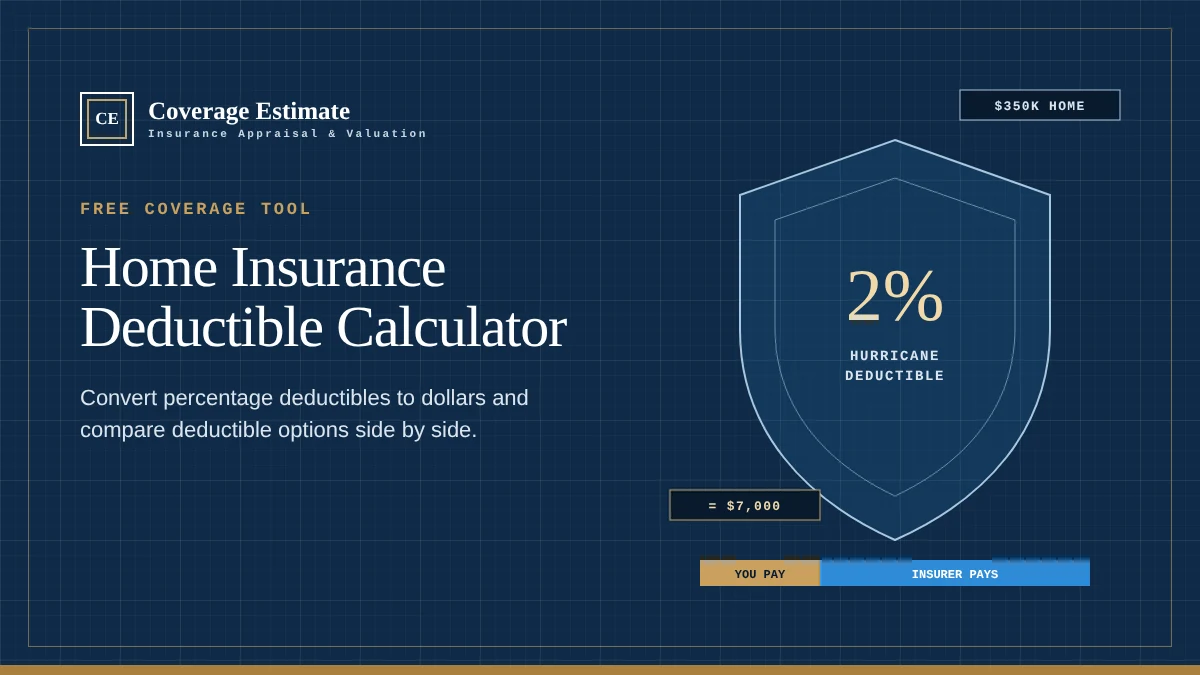
Most homeowners remember their deductible as a single number, often $1,000 or $2,500. Many policies, especially in coastal and hail-prone areas, carry a second or third deductible that applies only to certain causes of loss and is written as a percentage of the dwelling limit. A 2% hurricane deductible sounds small until you multiply it by a $350,000 dwelling limit and realize it is $7,000.
The other half of the decision is the premium. Raising your deductible lowers what you pay each year, but it raises what you pay when something goes wrong. Whether that trade makes sense depends on how much you save, how often you expect to claim, and how much cash you could produce on short notice.
This guide explains how home insurance deductibles work, the difference between flat and percentage deductibles, how hurricane and wind/hail deductibles differ, and how the calculator below decides which option has the lowest expected cost.
Use the Home Insurance Deductible Calculator
The calculator below has two parts. Part 1 works out the deductible on a specific claim, so it also works as a hurricane deductible calculator or wind deductible calculator when your policy uses a percentage deductible. Part 2 compares two or three deductible options from your quote.
It can help estimate:
- Which deductible applies to a claim, based on the cause of loss
- The dollar amount of a percentage hurricane, named storm, or wind/hail deductible
- What the insurer would pay and what you would pay out of pocket
- Annual premium savings and extra risk per claim for each deductible option
- Break-even years for a higher deductible
- Expected total cost of each option over a period you choose
- Whether each deductible fits within your emergency savings
The calculator processes entries locally in your browser. The information you enter is not transmitted or stored. Results are a preliminary planning estimate, not an insurance quote, coverage opinion, or claim determination.
How Home Insurance Deductibles Work
A deductible is the part of a covered loss you pay before the insurance company pays. If a covered fire causes $5,000 of damage and your deductible is $1,000, the insurer pays $4,000 and you absorb the first $1,000.
Three points cause most of the confusion.
First, the deductible comes off the covered loss. You usually do not mail the insurer a check; the adjuster calculates the covered damage, subtracts the deductible, and pays the rest, subject to the policy limit and other terms.
Second, if the damage is less than the deductible, the insurer pays nothing. A $1,800 repair under a $2,500 deductible is entirely yours, whether you file a claim or not.
Third, most homeowners deductibles apply per occurrence. Each separate event, such as a kitchen fire in March and a burst pipe in October, usually carries its own deductible. How a policy treats a hurricane season with more than one storm varies by state and policy; some apply a hurricane deductible once per season or calendar year, while others apply it to each storm. Your policy wording controls.
Flat Deductibles vs Percentage Deductibles
A homeowners policy can express a deductible in two ways.
A flat deductible is a fixed dollar amount, such as $1,000, $2,500, or $5,000. You know exactly what it is, and it does not change when your coverage limit changes.
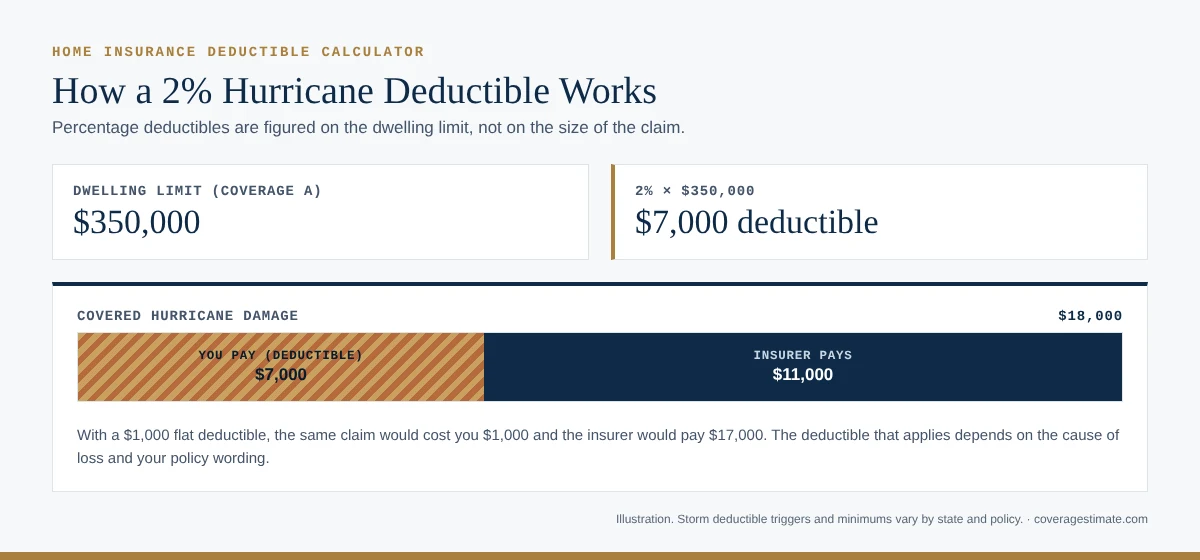
A percentage deductible is a percentage of the dwelling limit, which is Coverage A on your declarations page. It is not a percentage of the claim. A 2% deductible on a home insured for $350,000 is $7,000 whether the damage is $10,000 or $100,000.
| Dwelling Limit (Coverage A) | 1% Deductible | 2% Deductible | 5% Deductible |
|---|---|---|---|
| $200,000 | $2,000 | $4,000 | $10,000 |
| $350,000 | $3,500 | $7,000 | $17,500 |
| $500,000 | $5,000 | $10,000 | $25,000 |
| $750,000 | $7,500 | $15,000 | $37,500 |
Percentage deductibles grow automatically when your dwelling limit grows. If your insurer raises Coverage A at renewal to keep up with construction costs, a 2% deductible rises with it. That is one reason to know your real rebuilding cost. Our Home Replacement Cost Calculator can help you check whether your dwelling limit is realistic.
Hurricane, Named Storm, and Wind/Hail Deductibles
Many policies carry a standard deductible plus one or more deductibles that apply only to certain weather events.
All-Other-Perils Deductible
The all-other-perils (AOP) deductible applies to most covered losses that are not subject to a special deductible: fire, theft, lightning, sudden water damage, and similar events. It is usually a flat dollar amount, though some insurers offer it as a percentage.
Hurricane and Named Storm Deductibles
A hurricane or named storm deductible applies to damage caused by a qualifying storm. What makes a storm qualify, sometimes called the trigger, varies by state and by policy. Triggers can be tied to a hurricane watch or warning, a storm being named by the National Weather Service, or a storm reaching hurricane strength, and the window during which the deductible applies is also defined in the policy. The Insurance Information Institute describes hurricane deductibles as typically ranging from 1% to 5% of a home’s insured value, and some higher-risk areas can see more.
Wind and Hail Deductibles
A wind/hail or windstorm deductible applies to damage from wind or hail, often regardless of whether a named storm is involved. These are common in states with frequent hail and severe thunderstorms, and they are also usually written as a percentage of Coverage A. Some policies have only a wind/hail deductible, which then applies to hurricane wind damage as well.
| Deductible | Applies To | Usually Written As |
|---|---|---|
| All other perils | Fire, theft, sudden water damage, and most other covered losses | Flat dollar amount |
| Hurricane / named storm | Damage from a storm that meets the policy’s trigger | Percentage of Coverage A |
| Wind / hail | Wind or hail damage, often including non-hurricane storms | Percentage of Coverage A, sometimes flat |
How to Use the Calculator
Part 1: Deductible on a Claim
Dwelling limit (Coverage A). Enter the limit from your declarations page. Percentage deductibles are calculated from this number.
All-other-perils deductible. Choose flat dollar amount or percentage, then enter the figure from your declarations page.
Hurricane / named storm deductible. Enter the percentage, or leave it blank or at 0 if your policy has none.
Wind / hail deductible. Enter the percentage, or leave it blank or at 0 if your policy has none.
Sample claim amount. Enter the covered damage before the deductible.
Cause of loss. Choose fire, water, theft, or other; wind or hail; or hurricane or named storm. This decides which deductible applies.
Part 2: Compare Deductible Options
Options A, B, and C. For each option on your quote, enter the all-other-perils deductible and the annual premium. Option C is optional.
Emergency savings. Enter the cash you could use for a deductible without borrowing. This field is optional but powers the emergency-fund check.
Years to compare and claim frequency. Under Comparison Assumptions, choose how many years to compare and how often you expect to file a claim. If left blank, the calculator uses 10 years and one claim every 10 years.
How the Calculator Works
Which Deductible Applies
The calculator converts each deductible to dollars:
Percentage deductible = Coverage A × percentage
A percentage deductible that works out to less than your all-other-perils deductible is raised to the all-other-perils amount, and the results note when that happens. Many policies set a minimum dollar amount for percentage deductibles, but the exact rule varies, so check your declarations.
It then picks the deductible based on the cause of loss:
- Fire, water, theft, or other: the all-other-perils deductible
- Wind or hail: the wind/hail deductible if you entered one; otherwise the all-other-perils deductible
- Hurricane or named storm: the hurricane deductible if you entered one; otherwise the wind/hail deductible; otherwise the all-other-perils deductible
Insurer Payment and Out-of-Pocket Cost
Insurer payment = claim amount − deductible, never less than zero and never more than the Coverage A limit.
Your out-of-pocket = claim amount − insurer payment
The calculator also shows the deductible as a share of the claim, which makes it easy to see how much of a mid-sized loss a percentage deductible absorbs.
Comparing Deductible Options
The option with the lowest deductible is the baseline. For every other option:
Annual savings = baseline premium − option premium
Extra risk per claim = option deductible − baseline deductible
Break-even years = extra risk per claim ÷ annual savings
Break-even years tells you how many claim-free years it takes for the premium savings to cover the extra deductible on one claim. If an option has a higher deductible but does not cost less, the calculator shows “Never” and flags the quote for a second look.
The expected cost of each option over the comparison period is:
Expected claims = years ÷ claim interval
Expected total cost = (annual premium × years) + (expected claims × deductible)
The calculator assumes every claim exceeds the deductible, so each claim costs you the full deductible, and it holds premiums flat over the period. It recommends the option with the lowest expected total cost; if two options are within $1, it picks the lower deductible.
Emergency-Fund Check
When you enter emergency savings, the calculator flags any recommended deductible larger than 50% of that amount, and it flags a percentage storm deductible from Part 1 the same way. A deductible larger than your entire savings is shown as a higher-priority warning. The 50% threshold is a planning choice, not an industry rule: it leaves room for the other costs that tend to arrive with a claim, such as temporary repairs, a hotel night, or items your policy does not cover.
Example Home Insurance Deductible Calculation
Suppose a homeowner has the following:
- $350,000 dwelling limit (Coverage A)
- $1,000 flat all-other-perils deductible
- 2% hurricane deductible
- No separate wind/hail deductible
- $18,000 of covered damage from a hurricane
- A renewal quote with three options: $1,000 deductible for $3,200 a year, $2,500 for $2,950, and $5,000 for $2,750
- $12,000 in emergency savings
- A 10-year comparison with one claim expected every 10 years
Part 1. The hurricane deductible is 2% × $350,000 = $7,000. The insurer pays $18,000 − $7,000 = $11,000, and the homeowner pays $7,000, which is 38.9% of the claim. The $1,000 deductible would apply only to non-storm losses.
Part 2. Option A is the baseline because it has the lowest deductible.
| Measure | Option A | Option B | Option C |
|---|---|---|---|
| Deductible | $1,000 | $2,500 | $5,000 |
| Annual premium | $3,200 | $2,950 | $2,750 |
| Savings per year vs Option A | Baseline | $250 | $450 |
| Extra risk per claim | Baseline | $1,500 | $4,000 |
| Break-even | – | 6.0 years | 8.9 years |
| Premiums over 10 years | $32,000 | $29,500 | $27,500 |
| Expected deductibles (1.0 claim) | $1,000 | $2,500 | $5,000 |
| Expected total cost | $33,000 | $32,000 | $32,500 |
Option B has the lowest expected cost, $32,000, which is $1,000 less than Option A over 10 years. Option C saves the most each year, but at one claim per decade its larger deductible eats most of that saving.
The status block reads Storm Deductible Strains Savings. Option B’s $2,500 deductible is 21% of the homeowner’s savings, well within the 50% check. The $7,000 hurricane deductible, however, would use 58% of savings. On many policies, choosing a different all-other-perils deductible does not change the hurricane deductible, so this homeowner should plan for that $7,000 separately.
Click Load Example in the calculator to see these numbers.
When Raising Your Deductible Makes Sense
Should I raise my deductible? The calculator gives you the math, but the answer usually comes down to three tests.
The Break-Even Is Shorter Than Your Claim Interval
If a higher deductible pays for itself in six claim-free years and you expect to claim about once a decade, it is likely to come out ahead. If the break-even is 12 years and you have filed two claims in the last five, it probably will not.
You Can Pay the Higher Deductible Without Borrowing
A deductible you cannot afford is not a savings. If paying it would mean a credit card balance or delayed repairs that let damage spread, the lower premium is a false economy.
You Would Not File Small Claims Anyway
Many homeowners avoid filing small claims because claims history can affect future premiums and eligibility, depending on the insurer and the state. If you would pay a $2,000 repair yourself regardless, a $1,000 deductible may be protecting you against claims you will never file.
Raising a deductible makes less sense when savings are thin or when the quote shows only a small premium difference for a much larger deductible.
Small Claims and Your Deductible
When damage is only slightly above your deductible, the insurer’s payment is small, and the claim still goes on your record. A $3,000 claim under a $2,500 deductible pays $500.
Before filing a small claim, get a repair estimate, compare it with your deductible, and consider whether the net payment is worth a claim on your history. That said, do not underestimate damage that is hard to see. Water that has reached subfloors or wall cavities, or hail damage across a full roof, is often larger than it looks at first. For roof claims in particular, how the policy values an older roof can matter as much as the deductible; our Roof Depreciation Calculator shows how age can reduce a roof payment.
Deductibles and Claim Payments
The deductible is only one of several deductions that can stand between the damage and your check. If your policy pays actual cash value for some items, depreciation is subtracted as well, and the deductible is typically applied on top of it. Our Actual Cash Value Calculator explains how depreciation affects those payments.
On a large loss, the order of deductions and the policy limit matter. The calculator applies the deductible to the covered damage and caps the insurer’s payment at the Coverage A limit. Real claims can also involve separate limits for other structures, personal property, and additional living expenses, each with its own rules.
Common Deductible Mistakes
Not Knowing You Have a Percentage Deductible
Many homeowners learn about their hurricane or wind/hail deductible after the storm. Read the deductible section of your declarations page, not just the first number.
Comparing Premiums Without Comparing Risk
A quote that saves $450 a year with a deductible $4,000 higher needs about nine claim-free years to break even. Look at both numbers together.
Raising the Deductible Past Your Savings
The right deductible is one you could pay next month without hardship.
Limitations of the Home Insurance Deductible Calculator
The calculator is a planning tool. It does not:
- Read or interpret your policy, endorsements, or declarations page
- Decide whether a storm meets your policy’s hurricane or named storm trigger
- Account for state rules on how deductibles are applied, disclosed, or limited
- Handle per-season or calendar-year hurricane deductibles across multiple storms
- Include flood or earthquake deductibles, which are written under separate coverage
- Model depreciation, coverage exclusions, or sublimits
- Predict how often you will file a claim or how premiums will change
Claim frequency is your own assumption. Treat the expected-cost comparison as a way to frame the decision, not as a forecast.
Frequently Asked Questions
How is a hurricane deductible calculated?
A percentage hurricane deductible is usually the percentage multiplied by your dwelling (Coverage A) limit. A 2% deductible on a $350,000 dwelling limit is $7,000. Some policies set a minimum dollar amount, and some write the hurricane deductible as a flat amount instead. Your declarations page shows which applies.
Is a wind deductible the same as a hurricane deductible?
Not always. A hurricane or named storm deductible applies only to storms that meet the policy’s trigger. A wind/hail deductible can apply to any wind or hail damage, including ordinary thunderstorms. Some policies have one, some have both, and some have neither.
Is a higher deductible worth it?
It can be, when the premium savings recover the extra deductible faster than you expect to file claims and when you could pay the higher amount from savings. Use the break-even years and expected-cost results in the calculator to test your own quote.
Does the deductible apply to every claim?
In most policies, yes, each covered occurrence has its own deductible. Hurricane deductibles are sometimes applied once per season or year rather than per storm, depending on the state and policy.
What happens if the damage is less than my deductible?
The insurer pays nothing, and you cover the full repair cost. Many homeowners choose not to file in that situation, but if you are unsure how large the damage is, get an estimate first.
Final Thoughts
A deductible is easy to overlook when you buy a policy and impossible to ignore when you file a claim. Knowing the dollar amount of every deductible you carry, especially percentage storm deductibles, is the first step toward making sure a claim does not become a financial emergency.
Use the Home Insurance Deductible Calculator to convert your deductibles into dollars, then compare the options on your next renewal quote with the break-even and expected-cost results. If you are facing a claim and are unsure which deductible applies or how the payment was calculated, review your policy with a licensed professional or contact us to talk through the numbers.