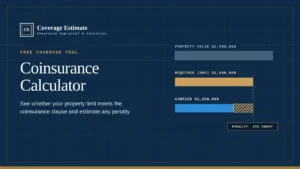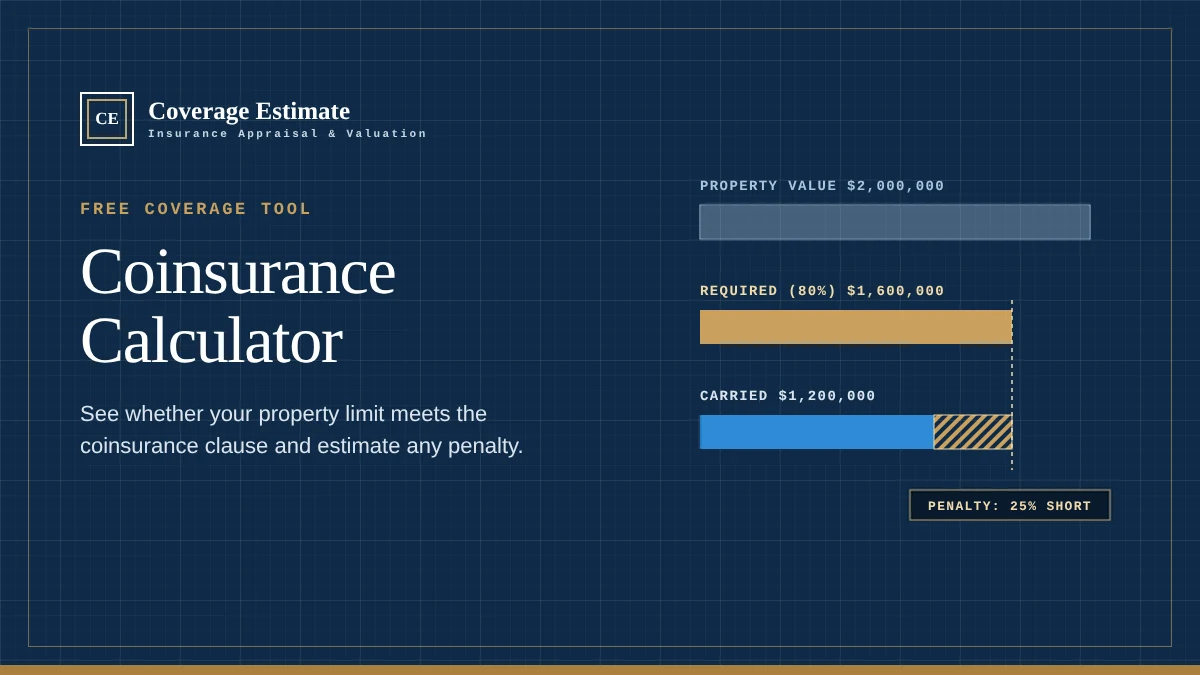
A coinsurance calculator shows whether a property insurance policy carries enough limit to satisfy its coinsurance clause and, if it does not, how much a coinsurance penalty would cut a claim payment. It takes a few numbers from the declarations page and the loss, applies the same steps an adjuster uses, and shows how the loss is split between the insurer and the policyholder.
That split can be a surprise.
A coinsurance clause does not take effect when the policy is bought or renewed. It applies on the day of a loss, using the property value on that day. A building that was insured properly five years ago can be underinsured today simply because construction costs went up. When that happens, the insurer pays only part of even a small partial loss, and the owner pays the rest.
A quick note before going further: this tool is for coinsurance clauses in property insurance, which appear mostly in commercial property policies and in some dwelling and condominium association policies. It is not for health insurance coinsurance, where the word means the percentage of medical bills a patient pays after the deductible. The two concepts share a name and nothing else.
This guide covers how to use the calculator, how the penalty is calculated, worked examples at 80%, 90%, and 100%, and how to avoid a penalty.
Use the Coinsurance Calculator
The calculator below applies the coinsurance method found in the standard ISO commercial property form to your figures.
It can help estimate:
- The amount of insurance the coinsurance clause requires
- Your coinsurance ratio (limit carried divided by limit required)
- Whether the requirement is met
- The estimated insurer payment for a loss
- The coinsurance penalty compared with a fully insured payment
- Your total out-of-pocket cost: deductible, penalty, and any loss above the limit
- The additional limit needed to meet the requirement
The calculator processes entries locally in your browser. The information you enter is not transmitted or stored. Results are a preliminary screening estimate based on simplified assumptions, not a claim adjustment or coverage opinion.
What Is a Coinsurance Clause?
A coinsurance clause is a condition in a property policy that requires you to insure the property for at least a stated percentage of its value. The percentage, usually 80%, 90%, or 100%, appears on the declarations page next to the limit.
If your limit meets that requirement at the time of loss, the insurer pays covered losses in full, minus the deductible, up to the limit. If your limit falls short, the insurer pays only a proportion of the loss. The shortfall you absorb is commonly called the coinsurance penalty.
The clause exists because most property losses are partial. If owners could insure a $1,000,000 building for $400,000 and still collect in full on every partial loss, they would pay far less premium than owners who insure to value, for nearly the same protection. Coinsurance keeps the premium fair across policyholders by rewarding those who carry a limit close to the property’s true value. Underwriters and agents call this principle insurance to value.
The Coinsurance Formula
In the commonly used ISO Building and Personal Property Coverage Form (CP 00 10), the coinsurance condition sets out four steps when the limit is too low:
- Multiply the value of the covered property at the time of loss by the coinsurance percentage. This is the insurance required.
- Divide the limit of insurance by the insurance required. This is the coinsurance ratio.
- Multiply the total amount of loss, before the deductible, by the ratio.
- Subtract the deductible.
The insurer pays that result or the limit of insurance, whichever is less. Written as one line:
Payment = (Limit carried ÷ Insurance required) × Loss − Deductible, capped at the limit
When the limit meets or exceeds the insurance required, the ratio is treated as 100%, so the payment is simply the loss minus the deductible, up to the limit.
Where Coinsurance Clauses Appear
Coinsurance is standard in commercial property policies covering buildings, business personal property, and business income. Condominium and homeowners association master policies are usually written on commercial property forms, so boards face the same requirement. Some dwelling fire policies used for rental properties include it as well.
Standard homeowners policies work a little differently. Many, including the widely used ISO HO-3 form, do not have a coinsurance clause, but they include a similar insurance-to-value test in the loss settlement section. If the dwelling limit is at least 80% of the home’s full replacement cost at the time of loss, building losses are paid at replacement cost up to the limit. If it is less, the policy pays the greater of the actual cash value of the damage or a proportion of the replacement cost. The arithmetic is related, but this calculator models the commercial coinsurance clause, not that homeowners provision. Homeowners who want to check their dwelling limit can start with our Home Replacement Cost Calculator.
How to Use the Calculator
Policy Valuation Basis
Choose replacement cost or actual cash value to match how your policy values the property. Coinsurance is measured on the same basis. If the policy settles losses at replacement cost, the property value used for coinsurance is its replacement cost. If it settles at actual cash value, the value is replacement cost minus depreciation. This selection only changes the guidance for the value field; the math is the same.
Property Value at Time of Loss
Enter what it would cost to rebuild or replace the covered property at the date of loss, on the basis you selected. For a building, that means construction cost, not market value, assessed value, or purchase price. Land is not part of it. If you are measuring actual cash value, our Actual Cash Value Calculator explains how depreciation is applied.
This is the input that most often decides the outcome, and it is the one owners most often underestimate.
Coinsurance Percentage
Select 80%, 90%, or 100% from your declarations, or choose Custom for another whole number between 50 and 100. Each coverage can carry its own percentage, so use the one shown for the property you are testing.
Limit of Insurance Carried
Enter the limit for the property being tested, for example the building limit. Do not combine building and contents limits unless they are written as a single blanket limit.
Amount of Loss
Enter the covered loss before the deductible, measured on the same valuation basis. The calculator will not accept a loss larger than the property value.
Deductible
Enter the deductible in dollars. If your policy has a percentage deductible, such as a 2% wind deductible, convert it to dollars first. Enter 0 if there is none.
Coinsurance Waived
Check this box only if the declarations show an agreed value or a coinsurance waiver for this property, the agreed value period has not expired, and the limit is at least the agreed value. When checked, the calculator applies no penalty.
How the Calculator Works
The calculator follows the ISO CP 00 10 steps in this order:
- Insurance required = property value × coinsurance percentage
- Coinsurance ratio = limit carried ÷ insurance required, treated as 100% when the requirement is met or coinsurance is waived
- Adjusted loss = amount of loss × coinsurance ratio
- Insurer payment = adjusted loss − deductible, no less than $0 and no more than the limit
It then compares that payment with what the same loss would pay with no coinsurance shortfall:
- Payment if fully insured = loss − deductible, no less than $0 and no more than the limit
- Coinsurance penalty = payment if fully insured − insurer payment
- Loss above the limit = any part of the loss, after the deductible, that exceeds the limit
- Total out-of-pocket = loss − insurer payment, which equals the deductible plus the penalty plus any loss above the limit
- Additional limit needed = insurance required − limit carried, when positive
The calculator also flags a thin margin when the limit meets the requirement by less than 10%. That threshold is a planning choice rather than an industry rule; it reflects the fact that values keep rising during a policy term while the limit usually stays fixed.
Deductible Order: Why Policy Wording Controls
The order of the deductible matters, and not every policy uses the same one. The ISO commercial property form applies the coinsurance ratio to the full loss first and subtracts the deductible last, and its deductible section confirms that the loss is first reduced for coinsurance. Some other forms, including some businessowners policies, subtract the deductible before applying the ratio. Manuscript and non-ISO forms may say something else again.
Using the example below, the ISO order produces a payment of $161,667. Subtracting the deductible first would produce ($750,000 ÷ $900,000) × ($200,000 − $5,000) = $162,500. The gap is small with a $5,000 deductible, but it grows with large percentage deductibles. The exact wording in your policy always controls.
Example Coinsurance Calculation
Suppose a commercial building has:
- Replacement cost at the time of loss: $1,000,000
- Replacement cost valuation
- 90% coinsurance
- Building limit: $750,000
- Covered fire loss: $200,000
- Deductible: $5,000
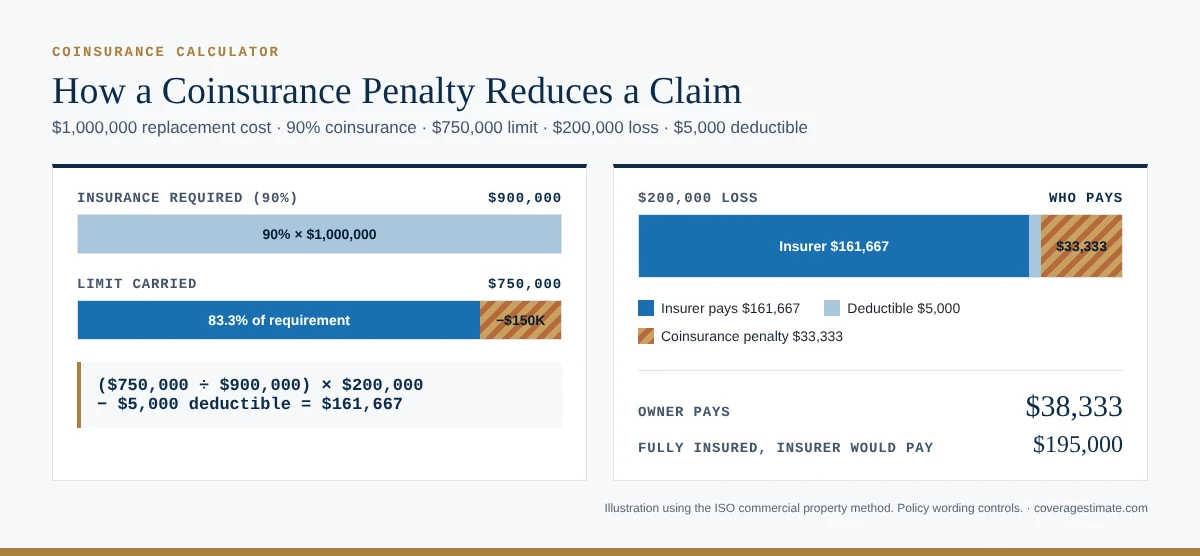
The insurance required is $1,000,000 × 90% = $900,000. The owner carries $750,000, so the requirement is not met.
The coinsurance ratio is $750,000 ÷ $900,000 = 83.3%.
The adjusted loss is $200,000 × 83.3% = $166,667. Subtracting the $5,000 deductible leaves an insurer payment of $161,667.
If the building had been insured to the requirement, the payment would have been $200,000 − $5,000 = $195,000. The coinsurance penalty is $33,333, and the owner’s total out-of-pocket cost is $38,333: the $5,000 deductible plus the $33,333 penalty.
To meet the requirement, the owner would need $150,000 of additional limit.
Click Load Example in the calculator to see these numbers.
Coinsurance at 80%, 90%, and 100%
The coinsurance percentage changes the result even when nothing else does. The table below uses the same building, limit, loss, and deductible as the example above.
| Coinsurance | Insurance Required | Ratio | Insurer Payment | Penalty | Owner Out-of-Pocket | Additional Limit Needed |
|---|---|---|---|---|---|---|
| 80% | $800,000 | 93.75% | $182,500 | $12,500 | $17,500 | $50,000 |
| 90% | $900,000 | 83.3% | $161,667 | $33,333 | $38,333 | $150,000 |
| 100% | $1,000,000 | 75% | $145,000 | $50,000 | $55,000 | $250,000 |
A higher coinsurance percentage usually earns a lower rate per $100 of insurance, but it leaves less room for error in the property value. At 100%, any understatement of value creates a penalty.
What Happens in a Total Loss
Coinsurance mostly affects partial losses. If the same building at 90% coinsurance were destroyed, the calculation would be ($750,000 ÷ $900,000) × $1,000,000 − $5,000 = $828,333. That exceeds the limit, so the insurer pays the $750,000 limit. The coinsurance penalty on that loss is $0, but the owner still absorbs $250,000: the deductible plus $245,000 of loss above the limit. Underinsurance hurts in a total loss too, just through the limit rather than the coinsurance clause.
How to Avoid a Coinsurance Penalty
Start With an Accurate Replacement Cost
Every other step depends on knowing what the property would cost to rebuild today. Property values reported at the original purchase, carried forward from an old statement of values, or based on market value are common sources of underinsurance. A replacement cost appraisal prepared by a qualified appraiser documents construction type, square footage, materials, and current local building costs, and it gives the underwriter a supported number.
Agreed Value Optional Coverage
The ISO commercial property form offers an Agreed Value optional coverage. When it is shown in the declarations, the coinsurance condition does not apply to that property until the expiration date listed for the agreed value. The insurer usually requires a signed statement of values to grant it.
Two details matter. First, agreed value is tied to a time period and must be renewed; if it lapses, coinsurance applies again. Second, if the limit is less than the agreed value, the insurer pays only the proportion of the loss that the limit bears to the agreed value, which works much like a coinsurance penalty.
Inflation Guard
Inflation guard coverage increases the limit automatically by an annual percentage, prorated over the policy term. It helps a correctly set limit keep pace with rising costs during the year. It does not fix a limit that was too low at the start of the policy.
Blanket Limits and Margin Clauses
Owners with several buildings, or with building and contents at one location, can sometimes insure them under a single blanket limit instead of separate limits for each item. Under the ISO form, coinsurance on blanket insurance is applied to the combined value of all property under the blanket, which gives some flexibility when one building is underreported and another is overreported.
Insurers often limit that flexibility with a margin clause. A margin clause caps what the policy will pay for any one building or location at a stated percentage of the value reported for it on the statement of values, for example 105% or 125%. A margin clause is a restriction, not a way to avoid coinsurance. It means an outdated statement of values can limit a recovery even when the total blanket limit is large. Blanket limits are most effective when the statement of values is current and agreed value is in force for the blanket.
Review Values at Every Renewal
Coinsurance is tested on the date of loss. Review the property value and limit at each renewal, after renovations or additions, and after periods of rapid construction cost growth.
Coinsurance, Insurance to Value, and Appraisals
Coinsurance is the policy language. Insurance to value is the practice that keeps you clear of it: carrying a limit equal to, or close to, the full replacement cost of the property.
For condominium and homeowners associations, the stakes are shared. An underinsured master policy can turn a coinsurance penalty or a shortfall above the limit into a special assessment for every owner. Boards can check a building’s limit with our Condo Replacement Cost Calculator, and many associations rely on a periodic professional appraisal to support the values they report to their insurer.
Coverage Estimate prepares replacement cost appraisals for insurance purposes. If the calculator shows a shortfall or a thin margin, contact us to discuss an appraisal before your next renewal.
Common Coinsurance Mistakes
Using Market Value or Purchase Price
Market value includes land and location and can be far above or below construction cost. Coinsurance is based on the value of the covered property itself.
Setting the Limit Once and Leaving It
A limit that met the requirement at purchase can fall short years later as construction costs rise.
Assuming the Clause Only Matters in a Total Loss
The penalty applies to partial losses, which are the most common claims.
Forgetting That Each Coverage Has Its Own Test
Building, business personal property, and business income can each carry a separate coinsurance percentage and limit.
Letting Agreed Value Lapse
Agreed value usually lasts for a stated period. If it is not renewed, coinsurance returns without notice to most owners.
Limitations of the Coinsurance Calculator
The calculator is a screening tool. It does not:
- Read or interpret your specific policy wording or endorsements
- Determine the property value at the time of loss
- Model forms that subtract the deductible before the coinsurance ratio
- Apply sublimits, exclusions, or separate deductibles for wind, hail, or other perils
- Model the homeowners replacement cost loss settlement provision
- Calculate business income coinsurance, which uses a different worksheet
- Determine whether a loss is covered
When a large loss involves a coinsurance dispute, policyholders often work with a licensed public adjuster or attorney.
Frequently Asked Questions
What does 80% coinsurance mean?
It means the policy requires a limit of at least 80% of the property’s value at the time of loss. On a building worth $1,000,000, the limit must be at least $800,000 to avoid a penalty.
How is a coinsurance penalty calculated?
Divide the limit carried by the insurance required, multiply the loss by that ratio, and subtract the deductible. The difference between that payment and what the loss would pay if fully insured is the penalty. Policy wording controls the exact order of steps.
Is coinsurance the same in health insurance and property insurance?
No. In health insurance, coinsurance is the share of medical costs you pay after the deductible. In property insurance, it is a clause requiring you to insure to a percentage of value. This calculator applies only to property insurance.
Does coinsurance apply to a total loss?
The clause still applies, but in most total losses the proportional payment exceeds the limit, so the insurer pays the limit. The owner absorbs the gap between the loss and the limit.
How can I avoid a coinsurance penalty?
Insure to an accurate, current replacement cost, ask about agreed value coverage, add inflation guard, keep the statement of values updated, and review the limit at every renewal.
Do homeowners policies have coinsurance?
Most standard homeowners policies do not have a coinsurance clause, but many include an 80% insurance-to-value test in their replacement cost loss settlement provision that can reduce payments in a similar way.
Final Thoughts
A coinsurance clause rewards accurate property values and penalizes outdated ones. The penalty rarely shows up until a claim, when it is too late to change the limit.
Use the Coinsurance Calculator to test your current limit against the requirement on your declarations page, then try a few higher property values to see how much margin you have. If the result shows a penalty or a thin margin, confirm the property’s replacement cost and talk with your agent about the limit, agreed value, and inflation guard before your next renewal.