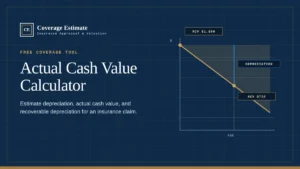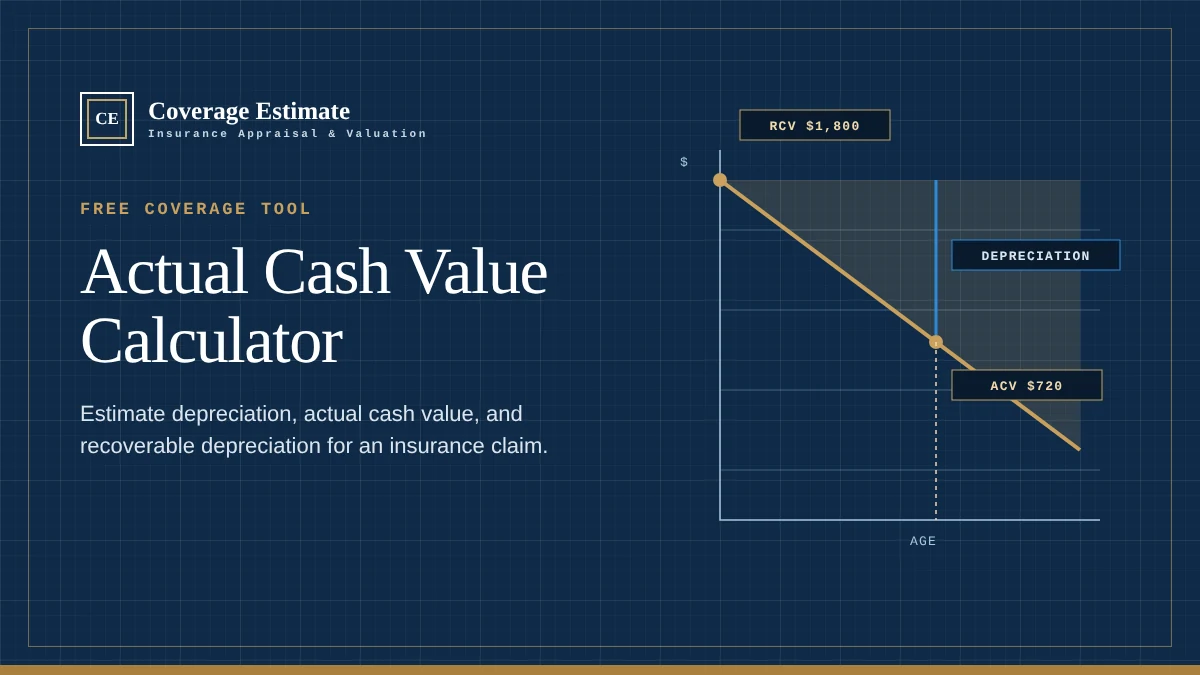
An actual cash value calculator shows what your damaged property is worth in the eyes of an insurance policy: the cost to replace it new, minus depreciation for age and wear. That number decides the size of the first check on most property claims, and on an actual cash value policy it may be the only check you receive. It does not replace a carrier’s estimate or a professional review, but it gives you a clear way to test the depreciation on your own claim before you accept it.
That test matters.
Depreciation is usually the largest single deduction on a contents or dwelling estimate, often larger than the deductible. It is calculated item by item, using an assumed useful life, the item’s age, and sometimes its condition. Small changes to any of those inputs can move the payment by hundreds or thousands of dollars.
Many policyholders never look at it. They see a total at the bottom of the estimate, deposit the check, and never learn that part of the depreciation was recoverable, or that a laptop was depreciated as if it were ten years old instead of three.
This guide explains how to use the calculator below, the difference between replacement cost and actual cash value, how recoverable depreciation works, the formulas the calculator uses, and how to push back when depreciation looks too high.
Use the Actual Cash Value Calculator
The calculator below estimates depreciation and actual cash value for up to 25 items in a property insurance claim, then applies your deductible and settlement type.
It can help estimate:
- Total replacement cost value (RCV) of the items you list
- Depreciation for each item and in total
- Total actual cash value (ACV)
- The initial ACV payment after your deductible
- Recoverable depreciation held back on a replacement cost policy
- Non-recoverable depreciation on an ACV-only policy
- The total potential payment after the items are replaced
The calculator processes entries locally in your browser. The information you enter is not transmitted or stored. Results are a preliminary planning estimate, not a claim determination, appraisal, or coverage opinion.
If the damage involves the structure of your home, our Home Replacement Cost Calculator can help you check whether your dwelling limit is high enough to rebuild, which is the figure replacement cost settlements start from.
Replacement Cost vs Actual Cash Value
Every property claim starts with the same question: what would it cost to replace the damaged item with a new one of like kind and quality? That figure is the replacement cost value, or RCV.
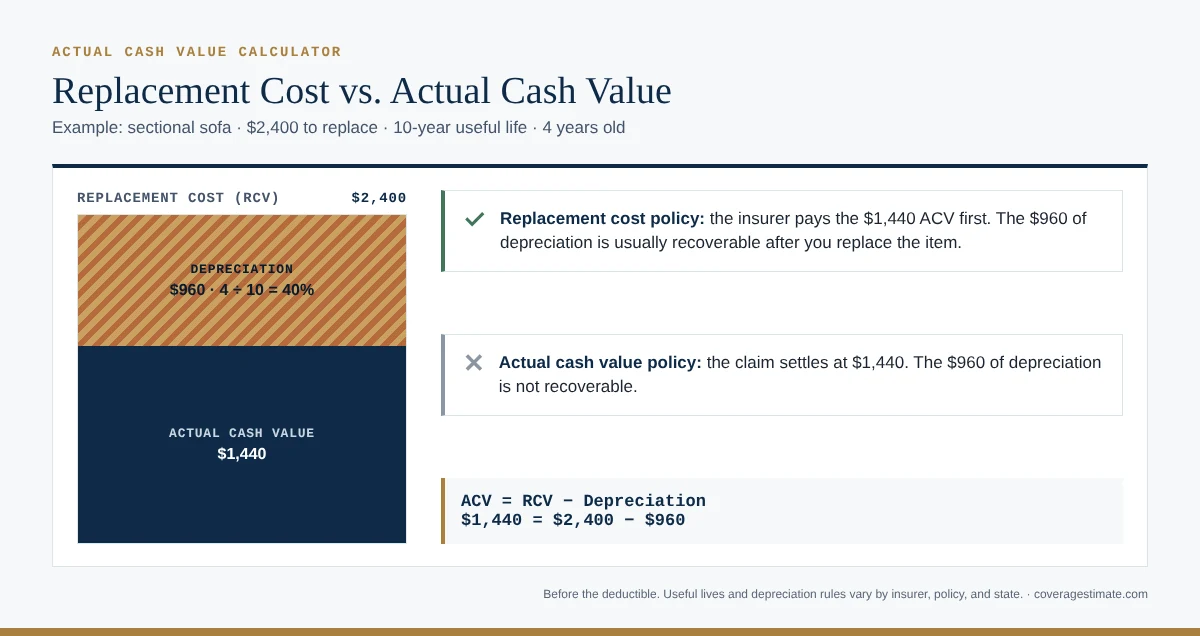
Actual cash value is the replacement cost minus depreciation. It is meant to reflect what the item was worth at the moment of the loss, given its age and condition. A five-year-old sofa that would cost $2,000 to replace new is not treated as a new sofa, so its ACV is lower than its RCV.
The basic relationship is simple:
Actual cash value = replacement cost value − depreciation
Some policies and some states define actual cash value differently, for example by reference to fair market value or a broader evaluation of all relevant evidence. The replacement-cost-minus-depreciation method is the most common approach on residential claims and is the one this calculator uses.
Recoverable vs Non-Recoverable Depreciation
Whether you ever see the depreciation again depends on how your policy settles losses.
| Policy Settlement Type | First Payment | After You Replace the Item |
|---|---|---|
| Replacement cost policy | Actual cash value, minus the deductible | Recoverable depreciation is released, typically after you submit proof of replacement |
| Actual cash value policy | Actual cash value, minus the deductible | Nothing further; the depreciation is non-recoverable |
On a replacement cost policy, the insurer usually pays the ACV first and holds back the depreciation. That holdback is called recoverable depreciation. Once you repair or replace the item and send receipts, invoices, or other proof, the carrier releases it, up to the actual amount you spent and subject to policy limits.
On an actual cash value policy, depreciation is a permanent reduction. It is non-recoverable depreciation, and replacing the item does not change the payment.
Two details vary by state and by policy, so confirm them in writing for your claim:
- The time limit to replace. Replacement cost policies usually require you to replace within a stated period to collect the holdback. The deadline, and whether it can be extended, depends on your policy language and your state.
- Depreciation of labor. Whether an insurer may depreciate the labor portion of a repair, not just materials, has been treated differently from state to state. The calculator treats each replacement cost as a single figure and does not separate labor from materials.
How to Use Each Input
Deductible
Enter the deductible that applies to this claim. If you have a separate wind, hail, or hurricane deductible expressed as a percentage, enter the dollar amount it represents. Enter 0 if the deductible has already been satisfied on another part of the same claim.
Settlement Type
Choose replacement cost if your policy pays recoverable depreciation after replacement, or actual cash value if it does not. Homeowners policies often settle the dwelling and personal property differently, so check the loss settlement section for the coverage this claim falls under.
Depreciation Cap
Open the Depreciation Cap section to change the maximum depreciation applied to any single item. The default is 80%. Many carriers and estimating programs cap depreciation so a functioning item keeps some minimum value after its expected life has passed. Caps differ by carrier and item type, so treat 80% as a planning assumption. Set it to 100% if you want to see pure straight-line depreciation with no floor.
Claim Line Items
Each item has five inputs:
- Item description: optional, but it makes the results table easier to match to your inventory.
- Category: sets the typical useful life in years. Choose Custom life to enter your own.
- Replacement cost new: what it would cost today to buy the same or a comparable item new, including sales tax if you want it counted.
- Age in years: how old the item was on the date of loss. Decimals are fine, such as 2.5.
- Condition: below average, average, or above average. This modestly adjusts the depreciation rate.
Use Add Another Item for up to 25 rows. Completely empty rows are ignored, so a spare row will not block the calculation.
How the Calculator Works
The calculator uses straight-line depreciation, the method most residential contents estimates start from.
Depreciation Rate for Each Item
Depreciation rate = (age ÷ useful life) × condition factor, capped at the maximum depreciation
The condition factors are:
- Below average: 1.10, which increases the rate by 10%
- Average: 1.00
- Above average: 0.90, which reduces the rate by 10%
If the result exceeds the cap, the cap is used instead. An item at or past its useful life will therefore show 80% depreciation with the default setting.
Depreciation and ACV for Each Item
Depreciation = replacement cost × depreciation rate
Item ACV = replacement cost − depreciation
Each item is rounded to the nearest cent, then the items are added together for total RCV, total depreciation, and total ACV.
Payments
Initial ACV payment = total ACV − deductible, but not less than $0
On a replacement cost policy:
Total potential payment = total RCV − deductible, but not less than $0
Recoverable depreciation held back = total potential payment − initial ACV payment
When the deductible is smaller than the total ACV, the recoverable depreciation equals the full depreciation. When the deductible is larger than the ACV, the rest of the deductible is absorbed by the depreciation released later, so the holdback is smaller.
On an actual cash value policy, the total potential payment equals the initial payment and all depreciation is shown as non-recoverable.
Example Actual Cash Value Calculation
Suppose a water loss damages five items in a home insured under a replacement cost policy with a $1,000 deductible:
| Item | Category and Useful Life | Replacement Cost | Age | Condition |
|---|---|---|---|---|
| Sectional sofa | Upholstered furniture, 10 years | $2,400 | 4 years | Average |
| 65-inch television | Televisions, 8 years | $1,200 | 3 years | Average |
| Laptop computer | Computers and phones, 4 years | $1,500 | 5 years | Average |
| Living room carpet and pad | Carpet and pad, 10 years | $3,000 | 6 years | Below average |
| Refrigerator | Major appliances, 12 years | $2,000 | 3 years | Above average |
The calculator works through each item:
- Sofa: 4 ÷ 10 = 40% depreciation, or $960, leaving an ACV of $1,440.
- Television: 3 ÷ 8 = 37.5%, or $450, leaving $750.
- Laptop: 5 ÷ 4 = 125%, which is capped at 80%, or $1,200, leaving $300.
- Carpet: 6 ÷ 10 = 60%, times 1.10 for below-average condition = 66%, or $1,980, leaving $1,020.
- Refrigerator: 3 ÷ 12 = 25%, times 0.90 for above-average condition = 22.5%, or $450, leaving $1,550.
Totals:
- Replacement cost value: $10,100
- Depreciation: $5,040, about 49.9% of replacement cost
- Actual cash value: $5,060
After the $1,000 deductible, the estimated initial ACV payment is $4,060. Because this is a replacement cost policy, $5,040 of recoverable depreciation is held back. If all five items are replaced for at least their replacement cost, the total potential payment is $9,100, which is the $10,100 replacement cost minus the deductible.
Under an actual cash value policy with the same items, the payment would stop at $4,060, and the $5,040 of depreciation would not be recoverable.
Click Load Example in the calculator to see these numbers.
Typical Useful Life by Item Category
The useful lives below are the values preset in the calculator. They are general planning guidelines drawn from commonly used depreciation ranges. Insurers, adjusters, and estimating software each use their own depreciation schedules, which may be longer or shorter, may vary by item quality, and may depreciate some items not at all.
| Category | Typical Useful Life Used |
|---|---|
| Electronics, general | 5 years |
| Computers and phones | 4 years |
| Televisions | 8 years |
| Major appliances | 12 years |
| Small appliances | 6 years |
| Furniture, upholstered | 10 years |
| Furniture, wood | 15 years |
| Mattresses | 8 years |
| Clothing, everyday | 4 years |
| Tools and sporting goods | 10 years |
| Carpet and pad | 10 years |
| Vinyl or laminate flooring | 20 years |
| Hardwood flooring | 50 years |
| Interior paint | 8 years |
| Cabinets | 25 years |
| Water heater (tank) | 10 years |
| HVAC (furnace or central AC) | 15 years |
| Asphalt shingle roof, 3-tab | 20 years |
| Asphalt shingle roof, architectural | 25 years |
If your carrier’s estimate shows a different life for an item, enter that life with the Custom life option to reproduce their math, then compare it with the preset value.
Factors That Affect Depreciation
Useful Life Assumptions
The useful life is the denominator of the formula, so it has the largest effect. Depreciating a solid wood dresser over 10 years instead of 15 increases its depreciation by half.
Age on the Date of Loss
Age should be measured from when the item was purchased or installed to the date of loss, not to the date of the estimate. Receipts, credit card statements, photos, and warranty registrations help prove it.
Condition
An item that was well maintained or rarely used can justify less depreciation than its age suggests. One that was already worn or damaged may justify more.
Item Type and Quality
Some items lose function with age; others hold their usefulness for decades. Many adjusters apply little or no depreciation to items such as some collectibles, artwork, or items that do not wear out with normal use. The calculator does not model appreciation.
Depreciation Caps and Minimum Values
A cap limits how far an item can be depreciated. Without one, a working refrigerator at 13 years would have no value at all, which rarely reflects reality.
How to Dispute Excessive Depreciation
If the carrier’s depreciation looks high, ask for the line-item estimate and review each entry. Common points to check:
- Wrong age. Make sure ages match your records. An estimate that defaults every item to the same age is a red flag.
- Short useful life. Compare the life used for each item with the general ranges above and with the item’s quality.
- Condition not considered. Provide photos and maintenance records showing the item’s condition before the loss.
- Depreciation on items that should have little or none. Ask why an item was depreciated and on what basis.
- Low replacement prices. Depreciation is a percentage of replacement cost, so an unrealistically low replacement price reduces both RCV and ACV. Provide current quotes or listings for comparable items.
- Recoverable depreciation not tracked. On a replacement cost policy, confirm the holdback amount and the deadline, then submit proof as you replace items.
Put your requests in writing and keep copies. Many policies include an appraisal provision for disputes over the amount of loss, and a public adjuster or attorney can help on larger claims. If you would like a second opinion on a carrier’s estimate, you can contact our team.
Common Actual Cash Value Mistakes
Accepting the First Check as Final
On a replacement cost policy, the first payment is usually ACV only. Many policyholders never claim the recoverable depreciation that follows.
Missing the Replacement Deadline
Recoverable depreciation generally depends on replacing items within the time your policy allows. Ask the carrier to confirm the deadline early.
Using Purchase Price Instead of Replacement Cost
Replacement cost is today’s price for a comparable new item, not what you paid years ago. Prices for many goods have risen, so the original receipt may understate RCV.
Forgetting Small Items
Individually minor items such as linens, kitchenware, and small electronics can add up. A thorough inventory often matters more than any single high-value item.
Assuming the Policy Is Replacement Cost
Some policies settle certain property, such as roofs past a stated age or contents under some forms, on an actual cash value basis. Read the loss settlement provisions rather than assuming.
Limitations of the Actual Cash Value Calculator
The calculator is a planning tool. It does not:
- Read or interpret your policy’s loss settlement language
- Apply your carrier’s depreciation schedule or estimating software
- Separate labor from materials or apply state rules on labor depreciation
- Determine replacement deadlines or the conditions for releasing depreciation
- Apply sublimits for jewelry, firearms, electronics, or other special categories
- Account for coinsurance penalties, policy limits, or overhead and profit
- Value antiques, collectibles, or items that may appreciate
Treat the results as a benchmark for reviewing a carrier’s estimate or preparing your own inventory, not as the amount you will be paid.
Frequently Asked Questions
How is actual cash value calculated?
Most residential claims calculate actual cash value as replacement cost minus depreciation. Depreciation is usually based on the item’s age divided by its expected useful life, sometimes adjusted for condition and limited by a cap. Some policies and states use other definitions, such as fair market value.
What is recoverable depreciation?
Recoverable depreciation is the portion of a replacement cost claim the insurer holds back from the first payment. It is typically paid after you repair or replace the item and submit proof, within the time allowed by your policy.
Is an actual cash value policy cheaper?
Actual cash value coverage generally costs less than replacement cost coverage, because the insurer’s payments are reduced by depreciation. The savings can disappear quickly after a large loss involving older items.
Can I negotiate depreciation on my insurance claim?
Yes. Depreciation is based on assumptions about age, useful life, and condition, and you can provide evidence to challenge any of them. Request the itemized estimate, document your items, and make your case in writing.
Does depreciation apply to labor?
It depends on your state and your policy. Some jurisdictions and policy forms allow labor to be depreciated, while others restrict it. Ask your carrier how labor was treated on your estimate and review the policy language.
What depreciation percentage do insurance companies use?
There is no single percentage. Carriers apply a rate for each item based on their own useful life tables, the item’s age, and its condition, and many cap depreciation at a maximum percentage. Our calculator uses straight-line depreciation with an 80% default cap as a planning assumption.
Final Thoughts
Depreciation decides how much of your claim you are paid up front and, on an actual cash value policy, how much you are paid at all. It is also one of the most negotiable parts of a property claim, because every line is built on assumptions you can check.
Use the Actual Cash Value Calculator to build a preliminary depreciation worksheet, compare it line by line with your carrier’s estimate, and identify the items where the age, useful life, or replacement price does not match your records. Then track your recoverable depreciation and replacement deadline so none of it goes unclaimed.
If you own a condo, our Condo Insurance Calculator can help you review whether your HO-6 policy settles personal property at replacement cost and carries limits that fit your unit.