A Condo Insurance Calculator helps unit owners answer two questions that most insurance quotes skip over: how much HO-6 coverage do you actually need, and roughly what should that coverage cost in your state? It does not replace a quote from a licensed agent, but it gives you a clear starting point before you shop, renew, or sign the closing documents on a new unit.
That starting point matters.
A condo policy is not a smaller version of a homeowners policy. It is designed to fit around the association’s master policy, and the right limits depend on what that master policy leaves out. Two owners with identical units in different buildings can need very different coverage simply because their associations insure the building differently.
Many owners never check. They accept the default limits on a quote, assume the HOA covers the rest, and find out after a burst pipe or a hurricane that the interior of their unit, or a large special assessment, was their responsibility all along.
This guide explains how to use the calculator below, what each part of an HO-6 policy covers, how the coverage limits and premium estimate are calculated, and how average condo insurance costs compare by state.
Use the Condo Insurance Calculator
The calculator below estimates recommended limits for each major part of a condo unit owner’s policy and a preliminary annual premium range.
It can help estimate:
- Coverage A: dwelling or walls-in coverage
- Coverage C: personal property
- Coverage D: loss of use
- Loss assessment coverage
- Coverage E: personal liability
- Your share of the HOA master policy deductible
- An estimated annual and monthly premium compared with your state average
The calculator processes entries locally in your browser. The information you enter is not transmitted or stored. Results are a preliminary planning estimate, not an insurance quote or coverage opinion.
If you serve on a condo board or manage an association, use our Condo Replacement Cost Calculator to check whether the building’s master policy limit keeps pace with reconstruction costs. An underinsured master policy can turn into a special assessment for every owner.
How Much Condo Insurance Do I Need?
For most unit owners, the answer comes down to five numbers:
| Coverage | What It Protects | Typical Starting Point |
|---|---|---|
| Coverage A: Dwelling (walls-in) | Interior finishes, fixtures, and improvements the master policy does not cover | $80 to $230 per square foot under a bare-walls master policy; much less under single-entity or all-in policies |
| Coverage C: Personal property | Furniture, electronics, clothing, and other belongings | The replacement cost of everything you own, often $25,000 to $75,000 |
| Coverage D: Loss of use | Temporary housing and extra living costs while the unit is repaired | 12 months of comparable rent, or 40% of Coverage C |
| Loss assessment | Your share of an HOA assessment after a covered loss, including the master deductible | At least $10,000, and more when the master deductible is large |
| Coverage E: Personal liability | Injuries or damage you cause to others | $300,000 minimum; $500,000 or an umbrella policy when you have significant assets |
The calculator works through each of these using your unit size, finish level, master policy type, belongings, association details, and assets.
What an HO-6 Policy Covers
An HO-6 policy, also called condo insurance or a unit owner’s policy, covers the parts of your financial exposure that the association’s master policy does not.
Coverage A: Dwelling or Walls-In Coverage
Coverage A pays to repair or rebuild the parts of the unit you are responsible for. Depending on your association’s documents, that may include:
- Interior drywall and paint
- Flooring
- Kitchen cabinets and countertops
- Bathroom fixtures and vanities
- Built-in appliances
- Interior doors and trim
- Electrical and plumbing fixtures inside the unit
- Upgrades you or a previous owner installed
This is usually the most misunderstood limit on a condo policy. It should be based on the cost to rebuild your interior, not the purchase price of the unit or its market value.
Coverage C: Personal Property
Coverage C protects belongings such as furniture, rugs, electronics, clothing, kitchenware, and artwork. Look for replacement cost coverage rather than actual cash value, which subtracts depreciation from claim payments.
High-value items such as jewelry, firearms, collectibles, and fine art often have low sublimits and may need to be scheduled separately.
Coverage D: Loss of Use
If a covered loss makes your unit uninhabitable, loss of use pays for temporary housing, meals above your normal costs, and similar expenses. In a large building, repairs after a fire or hurricane can take many months, especially when the association must first settle its own claim.
Loss Assessment Coverage
When the association suffers a covered loss, it may pass part of the cost to owners through a special assessment. The most common example is the master policy deductible. Loss assessment coverage pays your share, subject to your policy terms.
Many HO-6 policies include only $1,000 of loss assessment coverage by default. Higher limits are usually inexpensive to add.
Coverage E: Personal Liability and Medical Payments
Liability coverage protects you if someone is injured in your unit or if you accidentally damage another unit, for example when a washing machine hose fails and water travels to the units below.
Bare Walls, Single Entity, and All-In Master Policies
The single most important input in the calculator is what the HOA master policy covers. Your association’s declarations, bylaws, or insurance summary will usually describe it.
| Master Policy Type | What the HOA Insures | What Your HO-6 Must Cover |
|---|---|---|
| Bare walls | The structure, roof, exterior walls, and common areas only | Everything inside the unit: drywall, flooring, cabinets, fixtures, and improvements |
| Single entity | The structure plus original fixtures and finishes as built | Upgrades and improvements made after original construction |
| All-in (all-inclusive) | The structure, original finishes, and owner improvements | A small amount for items the master policy excludes |
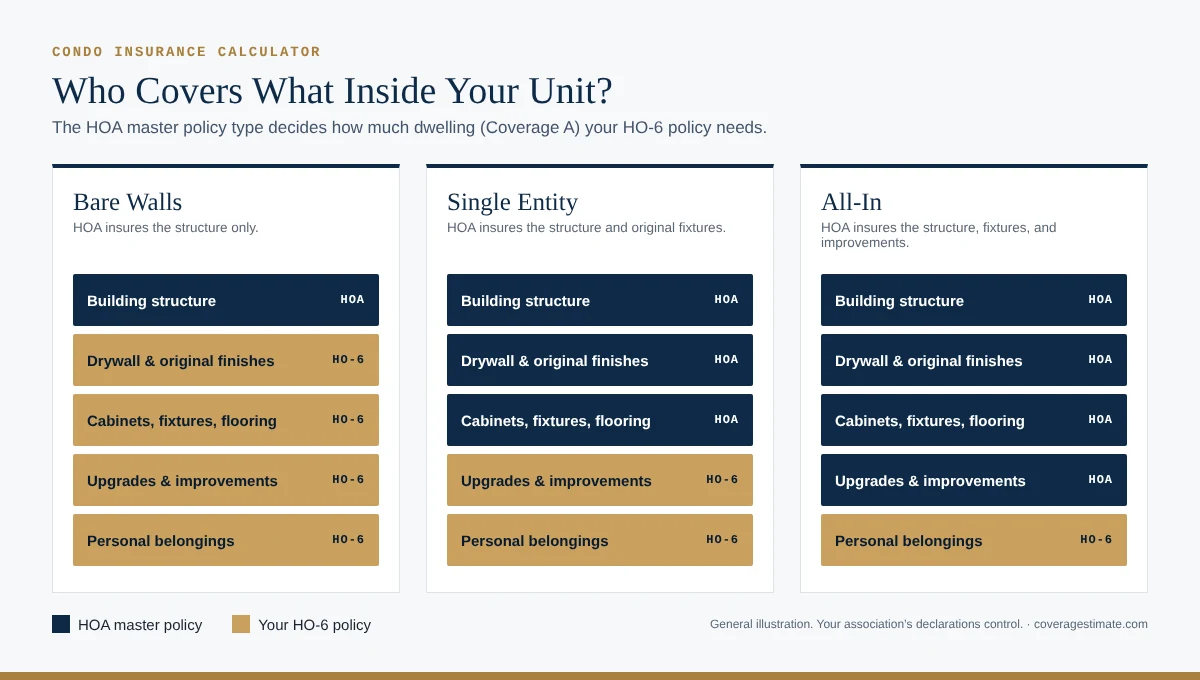
If you are not sure which type applies, choose “Not sure” in the calculator. It will assume a bare-walls policy, which produces the most conservative Coverage A estimate. Ask the association manager or board for a copy of the master policy declarations to confirm.
How the Calculator Works
The calculator follows a simplified sequence for each coverage.
Dwelling Coverage
The calculator first estimates the cost to rebuild the unit’s interior from the studs in:
Interior rebuild cost = unit square footage × finish cost per square foot × local cost adjustment
The finish levels used are:
- Standard or builder grade: $80 per square foot
- Mid-range: $115 per square foot
- High-end: $160 per square foot
- Luxury or custom: $230 per square foot
The local cost adjustment ranges from 0.9 for below-average construction markets to 1.3 for high-cost metro areas.
The calculator then applies the share left to you under your master policy type: 100% for bare walls, 25% for single entity, and 10% for all-in. It adds any upgrades you have made and rounds up to the nearest $5,000, with a $10,000 minimum.
Personal Property
If you enter the value of your belongings, the calculator uses it. If you leave it blank, it estimates $25 per square foot, with a $25,000 minimum. A room-by-room home inventory will always be more accurate.
Loss of Use
When you enter a monthly rent for comparable temporary housing, the calculator recommends 12 months of that rent. Otherwise, it uses 40% of Coverage C, a common default on HO-6 policies.
Loss Assessment
The calculator divides the HOA master policy deductible by the number of units to estimate your share, adds a 25% buffer, and rounds up to a common coverage tier of $10,000, $25,000, $50,000, $75,000, or $100,000. If you leave these fields blank, it assumes a $25,000 deductible and 50 units.
Actual assessments are allocated according to your association’s governing documents, often by ownership percentage rather than equal shares.
Liability
The recommendation is based on the assets you want to protect: $300,000 for under $300,000, $500,000 for $300,000 to $1 million, and $500,000 plus a $1 million umbrella policy above that.
Premium Estimate
The premium estimate starts with the average HO-6 premium for your state from the National Association of Insurance Commissioners (NAIC), adjusted upward by 25% to reflect rate increases since the most recent published data year. That figure is then scaled up or down based on how your recommended limits compare with a typical condo policy and adjusted for your deductible.
The result is shown as a midpoint with a likely range of 20% above and below it. Insurers price individual buildings very differently, so actual quotes may fall outside that range.
Example Condo Insurance Calculation
Suppose an owner in Florida has the following:
- 1,100 square foot unit
- Mid-range finishes
- Bare-walls master policy
- $15,000 in kitchen upgrades
- $40,000 in belongings
- $2,400 monthly rent for comparable temporary housing
- $750,000 HOA hurricane deductible shared by 60 units
- $300,000 to $1 million in assets
- $1,000 HO-6 deductible
The interior rebuild cost is 1,100 × $115 = $126,500. Adding $15,000 in upgrades gives $141,500, which rounds up to $145,000 of Coverage A.
Personal property is set at $40,000. Loss of use is 12 months × $2,400 = $28,800, rounded to $29,000.
The owner’s share of the hurricane deductible is $750,000 ÷ 60 = $12,500. With a 25% buffer, that becomes $15,625, so the calculator recommends $25,000 of loss assessment coverage.
Liability is set at $500,000.
Because these limits are well above a typical condo policy and Florida’s average premium is the highest in the country, the estimated premium is about $2,180 per year, with a likely range of roughly $1,740 to $2,620.
Click Load Example in the calculator to see these numbers.
How Much Does Condo Insurance Cost?
According to the NAIC, the national average HO-6 premium was $531 per year in its most recent published report, which covers 2021. Premiums have generally risen since then, particularly in states exposed to hurricanes and severe convective storms.
The table below shows the average annual HO-6 premium reported by the NAIC for each state.
| State | Average Annual HO-6 Premium (NAIC, 2021) |
|---|---|
| Alabama | $620 |
| Alaska | $435 |
| Arizona | $448 |
| Arkansas | $600 |
| California | $626 |
| Colorado | $484 |
| Connecticut | $411 |
| Delaware | $482 |
| District of Columbia | $370 |
| Florida | $1,049 |
| Georgia | $577 |
| Hawaii | $383 |
| Idaho | $465 |
| Illinois | $416 |
| Indiana | $366 |
| Iowa | $295 |
| Kansas | $392 |
| Kentucky | $405 |
| Louisiana | $818 |
| Maine | $389 |
| Maryland | $327 |
| Massachusetts | $442 |
| Michigan | $372 |
| Minnesota | $355 |
| Mississippi | $661 |
| Missouri | $406 |
| Montana | $508 |
| Nebraska | $378 |
| Nevada | $469 |
| New Hampshire | $374 |
| New Jersey | $446 |
| New Mexico | $448 |
| New York | $490 |
| North Carolina | $511 |
| North Dakota | $293 |
| Ohio | $327 |
| Oklahoma | $668 |
| Oregon | $384 |
| Pennsylvania | $398 |
| Rhode Island | $561 |
| South Carolina | $520 |
| South Dakota | $320 |
| Tennessee | $500 |
| Texas | $856 |
| Utah | $289 |
| Vermont | $359 |
| Virginia | $381 |
| Washington | $413 |
| West Virginia | $345 |
| Wisconsin | $276 |
| Wyoming | $451 (2020 data) |
Source: National Association of Insurance Commissioners, Dwelling Fire, Homeowners Owner-Occupied, and Homeowners Tenant and Condominium/Cooperative Unit Owner’s Insurance Report. State averages reflect the coverage owners actually purchased, so they are a benchmark, not a quote.
Factors That Affect Condo Insurance Premiums
Location and Catastrophe Exposure
Coastal wind, hail, wildfire, and freeze risk drive the largest differences between states and even between ZIP codes in the same state.
Coverage Limits
Higher Coverage A and Coverage C limits increase the premium. Under a bare-walls master policy, Coverage A is often the largest single driver of cost.
Deductible
Raising your deductible from $1,000 to $2,500 or $5,000 lowers the premium, but you will pay more out of pocket on every claim.
Building Age and Construction
Older plumbing and electrical systems, frame construction, and buildings without sprinklers can increase rates. Newer buildings with fire-resistive construction and modern wind protection often qualify for lower premiums.
Claims History and Rating Factors
Prior claims, and in many states a credit-based insurance score, affect individual pricing.
Endorsements
Water backup coverage, scheduled personal property, higher loss assessment limits, and building ordinance coverage add to the premium but can close important gaps.
Loss Assessment Coverage: The Most Overlooked Limit
Master policy deductibles have grown sharply, especially in Florida, along the Gulf Coast, and in hail-prone states. Many associations now carry windstorm or hurricane deductibles of 2% to 5% of the building’s insured value.
On a $30 million building, a 5% hurricane deductible is $1.5 million. Spread across 60 units, that is $25,000 per owner before the master policy pays anything.
Two details deserve careful review:
- The limit. A default $1,000 of loss assessment coverage does not come close to a share of a percentage deductible.
- The deductible assessment sublimit. Some policies limit how much of the loss assessment coverage applies to assessments for the master policy deductible, sometimes to $1,000 or less, unless you add an endorsement.
Ask your agent specifically whether your loss assessment coverage will pay your share of the association’s deductible, and up to what amount.
Common Condo Insurance Mistakes
Insuring the Purchase Price
The price of a condo includes land value, location, amenities, and market demand. None of that has anything to do with the cost to rebuild your interior.
Assuming the HOA Covers Everything Inside
Under a bare-walls policy, the association may not pay for a single cabinet, floor tile, or sheet of drywall inside your unit.
Forgetting Improvements
Renovated kitchens, upgraded flooring, and new bathrooms are often excluded under single-entity master policies. If Coverage A was set when you bought the unit, it may not include later upgrades.
Accepting the Default Loss Assessment Limit
The default limit on many policies is far below a realistic share of a modern master deductible.
Choosing Actual Cash Value
Actual cash value coverage subtracts depreciation from claim payments. Replacement cost coverage costs more, but it pays to replace damaged items with new ones of similar kind and quality.
Never Reviewing the Policy After Purchase
Construction costs, master policy terms, and your belongings all change. Review your coverage at each renewal, after any renovation, and whenever the association changes its insurance program.
Limitations of the Condo Insurance Calculator
The calculator is a planning tool. It does not:
- Read or interpret your association’s declarations or master policy
- Account for specific insurer pricing, discounts, or underwriting rules
- Include flood insurance, which standard HO-6 policies exclude
- Include earthquake coverage
- Evaluate scheduled jewelry, art, or collectibles
- Determine how your association allocates assessments
- Guarantee that any recommended limit is available or adequate
Premium estimates are derived from statewide averages and simplified assumptions. Treat them as a benchmark for comparing quotes, not as a price you will be offered.
Frequently Asked Questions
What is a good amount of condo insurance coverage?
There is no single number. Most owners should have enough Coverage A to rebuild the interior items the master policy excludes, enough Coverage C to replace their belongings, at least $300,000 in liability coverage, and loss assessment coverage that exceeds their share of the master policy deductible.
Is condo insurance required?
State law generally does not require it, but most mortgage lenders and many association bylaws do.
Does condo insurance cover water damage?
Most HO-6 policies cover sudden and accidental water damage, such as a burst pipe. Gradual leaks, maintenance issues, and flooding from outside are usually excluded. Water backup from drains often requires an endorsement.
Does an HO-6 policy cover the building?
No. The association’s master policy covers the building structure and common areas. The HO-6 covers your interior, belongings, liability, and your share of certain assessments.
How much is condo insurance per month?
Based on NAIC data, the national average is about $44 per month, but costs range from roughly $23 per month in the lowest-cost states to more than $85 per month in Florida, before recent rate increases.
Final Thoughts
The right condo insurance policy starts with understanding what the association already covers. Once you know the master policy type and deductible, the remaining limits are straightforward to estimate.
Use the Condo Insurance Calculator to build a preliminary coverage worksheet, then compare it with your current declarations page or with quotes from licensed agents. If the results show a large gap in dwelling or loss assessment coverage, review your association’s documents and discuss the numbers with an insurance professional before your next renewal.
If you are on the board and want to confirm the building itself is properly insured, start with our Condo Replacement Cost Calculator.